
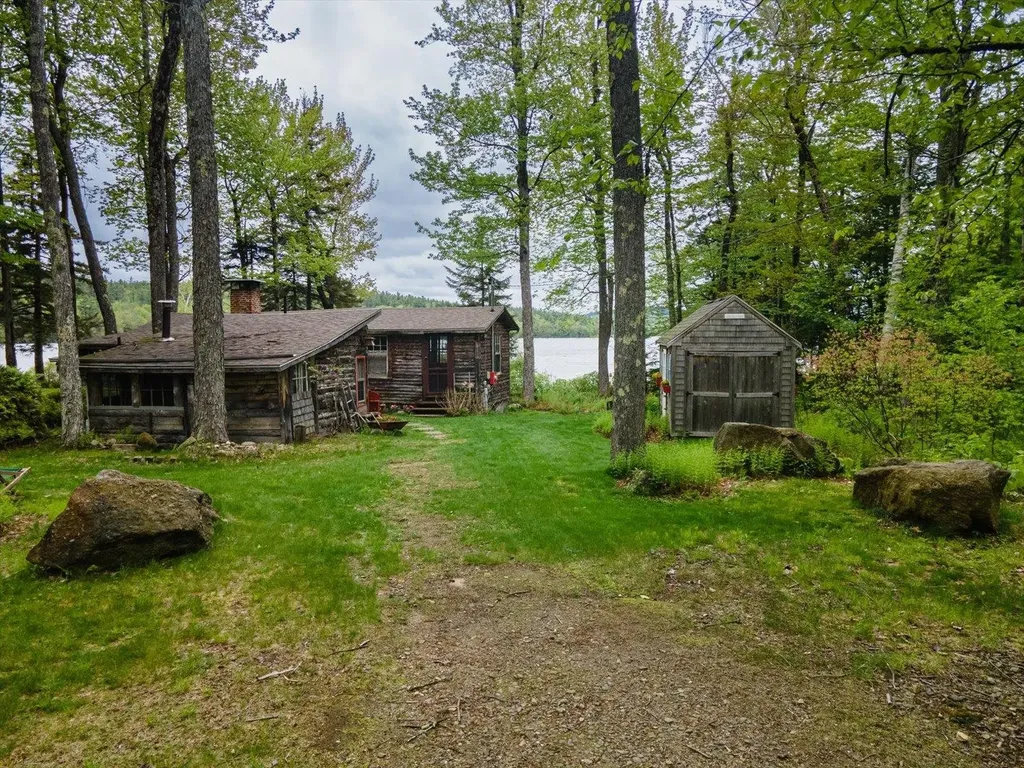
Nestled in southwest New Hampshire, on the shores of Lake Nubanusit, sits a century-old legacy that has been largely unknown until now. Recently listed at $3.3 million, buyers are stepping back in time as they explore, firsthand, one of the last remaining classic New England camps, “The Birches”, and the story of the Gilmore family that dramatically shaped Lake Nubanusit as we see it today.
The legacy of Howard Gilmore and his family dates back to the early 1900s, when the family discovered Lake Nubanusit. A successful inventor, Gilmore amassed his fortune through his iteration of Thomas Edison’s light bulb, which leverages a strong filament in addition to other improvements. Overall, his six U.S. patents, filed between 1899 and 1909, guaranteed him a percentage of light bulb sales connected to his design.
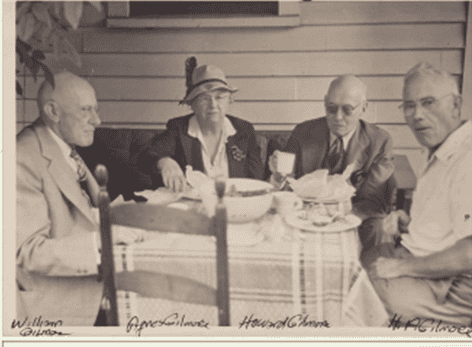
From left: William Gilmore, Agnes Gilmore (Howard’s wife), Howard Gilmore, and H.P. Gilmore.
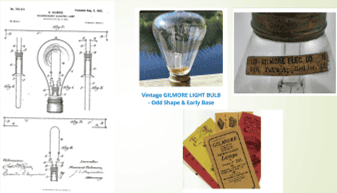
Photo of Howard Gilmore’s patents and iterations on the light bulb.
With his fortune made and dream location found, Howard Gilmore and his nephew, H.P. Gilmore, began shaping their legacy at Lake Nubanusit. In 1905, the Gilmores purchased the lot that would become “The Birches” at 138 Miller Drive in Nelson, the first of four family-related camps.
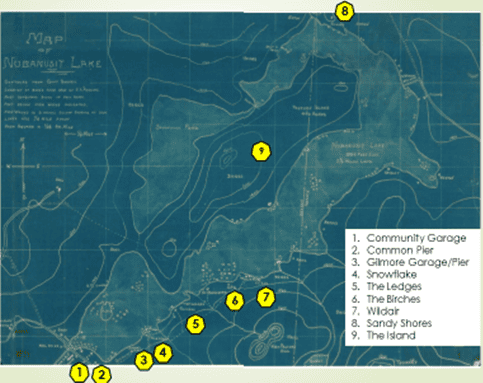
Howard Gilmore’s Map with points of interest, including his four camps, including The Birches at 138 Miller Drive (#6), community garage, and community pier in Nelson, NH.
The Birches (currently on market)
Howard and his wife, Agnes, did not have any children of their own; their nephew, H.P. Gilmore, acted as a sort of surrogate son. In conversation, Howard and H.P. were distinguished by locals as “Old Howard” and “Young Howard.”
According to Gilmore family lore, Young Howard was an avid sportsman. So, leveraging his uncle's financial backing, Young Howard searched all of New England in his Model T for the ideal four-season hunting and fishing camp, and selected Nubanusit Lake. He chose five acres around where Tenney Brook enters the lake, just northeast of The Narrows, for his camp. With the help of the Uptons, a local farming family close to the Gilmores, Young Howard built The Birches using wood milled and fieldstones gathered from the lot, most of which remain today.
Today, The Birches has the address of 138 Miller Drive, but Miller Drive did not exist until the 1950s. Like many lake residents, the Gilmores accessed their land by foot year-round using a network of trails, and by boat in the summer or by ice in the winter.
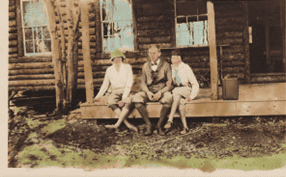
“Young Howard” with others at The Birches.
Much like in 1905, nature surrounds this serene property, with the Harris Center Supersanctuary, a 36,000-acre protected land area. The Birches boasts 428 feet of lake frontage (one of the widest on the lake) and faces a nature preserve on the opposite shore. The privacy it offers is unparalleled by anything found in the region.
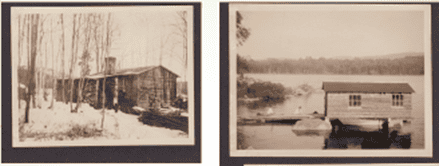
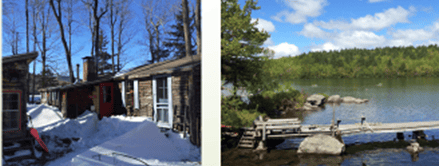
Photos of The Birches Then vs. Now
It’s no wonder the Gilmore family has photo albums full of the hunting and fishing that took place at and around The Birches. Young Howard’s daughter-in-law, Ruth Gilmore, was fondly remembered by neighbors for her time on the dock and her walks to a local spring to collect jugs of water every day. For four generations, Young Howard’s family has enjoyed calling The Birches their home away from home.
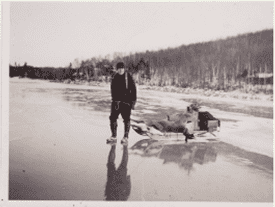
Photo of an unidentified hunter. The Birches with snow-covered roof on the right.
In 2012, the family sold The Birches to owners who have lovingly preserved the property in the years since. And recently, The Birches have been placed back on the market for $3.3M.
“The main cabin's bedroom welcomes the morning light through three large windows that frame the lake. A stone hearth anchors the family room, lit by large north- and west-facing windows. The screened porch offers sweeping 180-degree water views and a gentle breeze. The kitchen is both charming and functional, featuring a Diva stove and original cabinetry that conceals modern appliances,” reads the property description.
“It’s like stepping into a different world,” shared listing agent Denise Whitney from Better Homes and Gardens Real Estate The Masiello Group. “It’s truly a place to get away, go back in time, and enjoy the beauty that New Hampshire has to offer.”
The Ledges
After Young Howard built The Birches, his uncle decided to join the fun and built The Ledges.
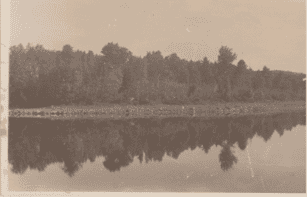
Photo of the ledges before The Ledges.
To the onlooker, the home itself serves as a local landmark, distinguished by its bell tower. Longtime lake residents like David Robinson all recall tales ringing of The Ledge’s majesty.
“…he asked me if I was ready,” David shared as he recalled his lesson on navigating the “dreaded Narrows” before the age of buoys. “‘Well, put the bow on the bell and keep Elephant Rock dead on the stern. Steady as she goes.’ Before I knew it, we were through the narrows. All Ned did was smile and puff on his pipe.”[1]
Snowflake
In 1926, Old Howard also built a more accessible winter cabin on Nubanusit Lake. Easily accessible from Nubanusit Road in winter by snowshoe and toboggan, the Gilmore's ensured nothing would prevent them from life on the lake.
In an excerpt from Win Hersey’s journal, who later purchased the cabin from Mrs. Gilmore after Howard’s passing, we get a small glimpse of those winter days with Gilmore and friends.
January 8th, 1955: “Clear – 24°…Lake frozen solid (10”)…Arrived noon. Frankie has built fire; camp warm.”
“I think one might properly say that Old Howard never left the shores until he died,” recalls Win Hersey’s daughter, Karen. “When purchased by my father, Snowflake was decorated with stuffed deer heads, moose heads, and wild cat hunting trophies.”
Sandy Shores
Purchased in 1917 and built in 1919, Old Howard’s final camp was dubbed “Sandy Shores.” Easily visible in the northeast corner of the lake, and later sold to the Briggs family, who, in 1970, developed the Harris Center for Conservation.
Frankie Upton, a close friend of Howard, recalls that, despite owning The Ledges, Gilmore “would invite many friends up for weekends. On Saturday nights, Gilmore would take a boatful of people up the lake, and they’d hike up through the woods to this cabin, have a fire. On Sunday … they’d row back again.”[2]
The Garage
Unlike residents of Howard’s camps today, who find themselves 20 minutes away from Groceries and fine dining, Howard Gilmore and his peers accessed their camps primarily by boat or hiking trails. Accessing nearby towns like Harrisville or Chesham would require a car or train. Some non-Gilmore-related locations, such as Spalding’s camp and a relatively new Haupt camp, are accessible only by boat to this day.
According to Dick Gilmore, H.P. Gilmore’s grandson, Howard would often take non-passenger trains up from Boston to Harrisville station. Riding alongside the engineer and playing Pinochle along the way.
However, to account for the lack of roads leading to these camps, a multi-car “Community Garage” and pier were constructed (no doubt thanks to the influence and backing of Gilmore). In addition to Gilmore, the garage was truly designed for the community. Lake resident David Beffa-Negrini noted that the deed for Nubanusit property included storage rights in the garage’s second bay.
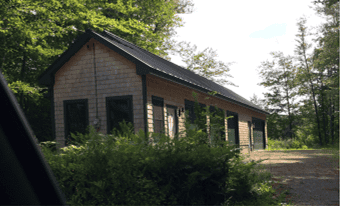
A photo of the community garage rebuilt in 2012.
When guests arrived at the community garage, they were instructed to “call” the camps using a closed-loop phone located in the garage’s small office. To this day, near Gilmore’s Snowflake camp, you can find the old blue phone box that acted as the receiving end to the calls of Gilmore’s camp arrivals.
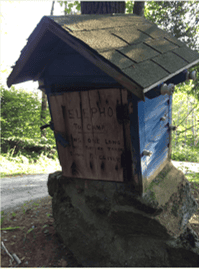
A photo of the phone box to “Snowflake” still standing at Old Camp Road.
The Pier & Trails
As water was a primary means of accessing the camps, a community pier was added next to the garage. According to Barry Tolman, the pier had berths to cover six boats, three on each side.
Margot Miller describes how her uncle and aunt used “great big dories built on Cape Cod and powered by Johnson Outboard motors” to get to “Wildair,” their camp on Nubanusit.
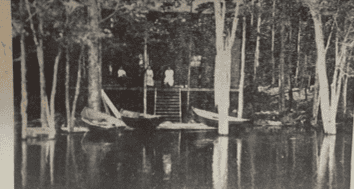
A postcard of “Austin’s Camp” suggests the kinds of boats early residents were using.
For foot traffic, the Gilmores and other lake residents staked out an elaborate network of trails connecting the dam with the camps. A 1932 map of the area showcases a network to The Birches and other Gilmore camps as well as the “Narrows” (then owned by Dr. D.W. Bowers) and, at the trail's end, a location labeled “Saw Dust” pile. The deeds of each home provided rights-of-way to these trails, which were often passed down with property ownership.
To help guests find their way to Nelson,, the Gilmores created postcards with directions to the various camps to be mailed well before the visit. (This was before the invention of GPS, after all.) These whimsical featured roads, local landmarks and even some train scheduling information.
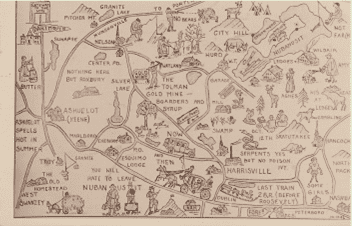
An actual postcard that Gillmore sent to their visitors with directions to the camp.
A Legacy Preserved
Although the Gilmores left Lake Nubanusit in 2012, their legacy endures in the preservation of Nelson’s natural beauty. Whomever ends up calling the newly listed Birches home will be added to the long line of those who recognize the beauty and tranquility that Lake Nubanusit offers.
To this day, when visitors to Lake Nubanusit kayak through the “dreaded Narrows,” hike through the pristine wilderness, or enjoy a drive down Long Pond Miller Drive, they are playing their role in a century-long legacy. And, if they pay extra close attention, they’ll see sure signs of its forefathers – families like the Uptons, the Herseys, and, of course, the Gilmores.
Citations:
[1] Letter from David Robinson letter to author, August 2017.
[2] Clark/Robinson/Rossiter, page 126. Upton notes that the chimney from Gilmore’s camp was still standing as of the interview in 1988.



Connect